Traffic Citation Checklist Before You Pay
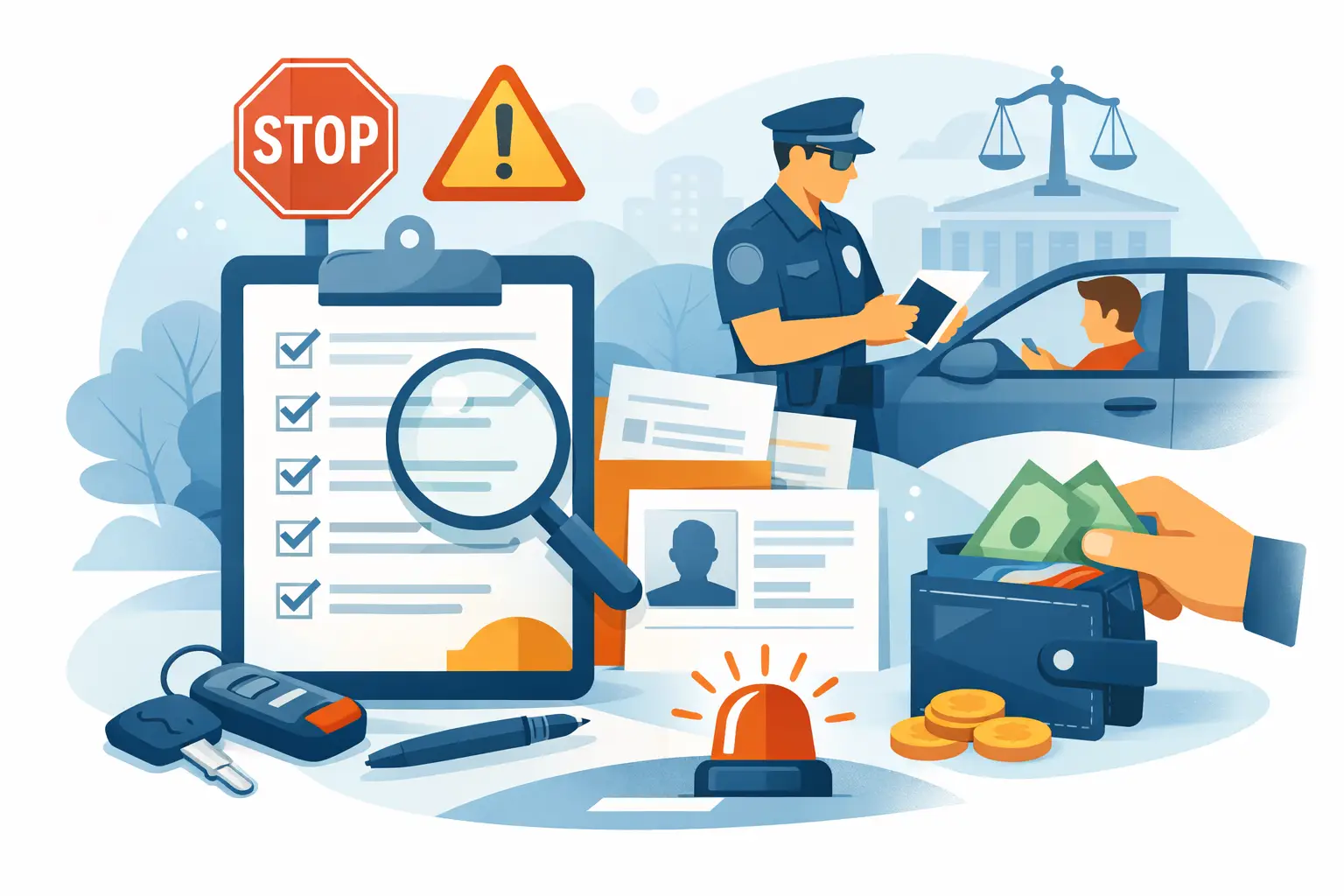
A traffic citation checklist gives you a chance to slow down before a ticket turns into a quick payment, a missed deadline, or an insurance surprise. In California, the fine listed on your notice is only one part of the decision. The citation details, the court date, the alleged violation, and the evidence available can all affect what you do next.
Start while the event is still fresh. Your goal is not to invent a defense or assume a typo makes a ticket disappear. It is to preserve facts, identify questions, and make an informed decision before you pay or respond to the court.
Traffic Citation Checklist: Start With the Ticket
Read every line of the citation, including the officer's handwritten notes, violation code, location, date, time, vehicle information, and signature areas. Compare those details with what you remember and with your registration and driver's license. A mismatch may matter, but it does not automatically invalidate a citation. The practical question is whether an error creates uncertainty about the alleged event or is simply a minor clerical issue.
Confirm the violation code rather than relying on a general description such as "speeding" or "unsafe turn." California traffic rules can depend on specific facts. For example, an alleged speed violation may involve the posted limit, the basic speed law, a construction zone, a school zone, or another statute with different elements.
Also check the response instructions carefully. Your paperwork may show a court appearance date, a deadline to resolve the citation, instructions for traffic school eligibility, or a later notice from the court. Do not assume the date printed on the ticket is your only deadline. Save copies of every document and note when you received it.
Write Down What Happened Before Memory Fades
Your own contemporaneous notes can be useful even when they are not formal evidence. Write a straightforward account of the stop: where you were going, the direction of travel, traffic volume, lane position, lighting, weather, and what the officer said. Include what you observed, not what you wish had happened.
Be specific about timing. If the officer said you were traveling at a certain speed, note whether you saw the patrol vehicle before the stop, how far away it was, whether other vehicles were nearby, and whether you changed lanes or speed before contact. If the citation involves a stop sign, signal, cell phone, lane change, equipment issue, or registration matter, record the conditions that relate directly to that allegation.
If passengers were present, ask them to write their own factual recollection separately. Independent notes are generally more useful than a group account written after everyone has compared stories.
Preserve Road, Weather, and Vehicle Evidence
Evidence changes quickly. Road work ends, signs are moved, trees grow over signals, and weather conditions disappear. If it is safe and lawful to do so, return to the area and take clear photos or video from the relevant approach. Capture the full context, not just one close-up image.
For a roadway-based citation, document the posted signs, signal visibility, lane markings, intersections, sight lines, road surface, construction activity, and any obstruction that could affect what a driver or officer could see. Note the date and time you collected the material. Conditions may not be identical to the day of the stop, so avoid overstating what a later photo proves.
For an equipment-related citation, keep records showing what you repaired or inspected. A receipt may help establish that a problem was addressed, but whether that affects the case depends on the alleged violation and local court process. Fixing an issue is often sensible, yet it is not a promise that the citation will be dismissed.
Review Speed, Radar, and LiDAR Context
A speed-related ticket deserves a closer factual review because the method of observation matters. Look for any indication of radar, LiDAR, pacing, an estimated speed, or a speed measurement device. The citation itself may not include every detail, so your notes about the officer's statements are relevant.
Consider the conditions around the measurement. Were there multiple vehicles traveling close together? Was there a curve, hill, overpass, large vehicle, or heavy traffic between the patrol unit and your vehicle? Was the officer positioned where identification of one specific vehicle could be difficult? These questions do not establish an error by themselves, but they can identify areas that deserve review.
Weather and road conditions can cut both ways. Rain, glare, fog, poor lighting, or traffic congestion may affect visibility and measurement context. They may also support the officer's view that a lower speed was reasonable under the circumstances. A credible review looks at both possibilities rather than treating every condition as a defense.
Check the Officer-Procedure and Paperwork Details
Review whether the citation clearly identifies the alleged conduct and location. Look for missing or unclear information, conflicting times, an incorrect vehicle description, an unreadable statute number, or facts that do not appear to fit the charge. Again, not every paperwork defect changes the outcome. Courts often distinguish between an error that causes real confusion and one that can be corrected without affecting the allegation.
Pay attention to the court paperwork you receive after the stop. The amount due, appearance instructions, traffic school information, and any notices about extensions or proof of correction can affect your options. Keep a simple file with the original ticket, court notices, photos, receipts, written recollections, and any correspondence.
Do not ignore a citation because you believe it contains an error. Missing a required appearance or response can create additional problems, including a failure-to-appear issue. If you are uncertain about a deadline, verify it through the court listed on your paperwork.
Decide What You Need Before Taking Action
Once you have the facts and documents in one place, decide what level of help makes sense. Some drivers may choose to pay, request traffic school if eligible, correct an equipment issue, or handle a court appearance on their own. Others may want a document-based review before making that choice, particularly when the ticket could affect work, insurance, a commercial driving role, or a driving record.
JusticeDrive can review uploaded California traffic tickets for possible factual, evidentiary, measurement-context, environmental, procedural, and court-paperwork issues before you decide how to proceed. An initial review can help organize the questions raised by your specific citation, while an optional court-ready packet can help drivers prepare materials in a structured way.
That review is not legal representation, and JusticeDrive is not a law firm. No ticket analysis can guarantee dismissal, a reduced fine, traffic school eligibility, or any particular court result. If your situation involves serious consequences, a suspended license, a collision, criminal allegations, or a commercial license, consider whether you need advice from a qualified California attorney.
Use the Checklist to Create a Clear Record
The value of a checklist is not that it turns every citation into a fight. It helps you avoid making a decision based only on stress, a deadline, or the assumption that nothing can be reviewed. A careful record lets you see what is known, what is missing, and what questions are worth asking before you pay.
Give yourself enough time to gather the ticket, court notice, photos, notes, and repair records. Then choose a next step that fits the actual facts, the deadline, and the consequences that matter to you.