Radar Versus LiDAR Evidence on California Tickets
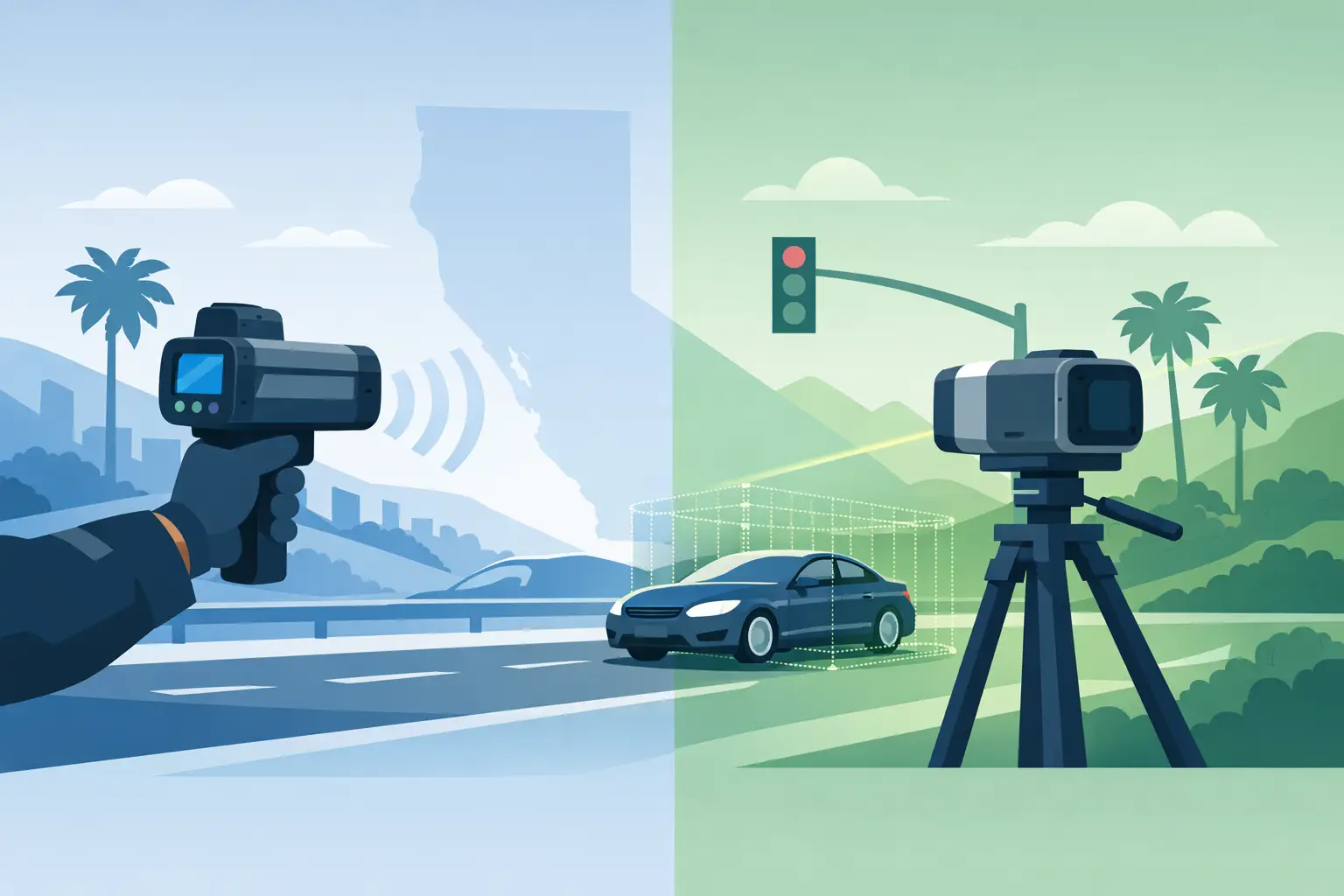
A speeding ticket can look settled the moment an officer says a device measured your speed. But radar versus lidar evidence is not just about which number appeared on a screen. The useful question is whether the measurement, the officer’s observations, the roadway conditions, and the required supporting records fit together.
For California drivers, that distinction can matter before paying a fine, accepting traffic school, or deciding whether to contest the citation. A device reading may be persuasive evidence, but it is not automatically the whole case. Your citation itself may not contain every detail needed to evaluate it, which is why the ticket, court paperwork, and available evidence should be reviewed as a set.
Radar Versus LiDAR Evidence: The Basic Difference
Radar measures speed by transmitting radio waves and analyzing the reflected signal. It can measure approaching or receding vehicles and may be used from a stationary patrol car or, in some circumstances, a moving one. Because radar can cover a broader area, the officer’s ability to identify which vehicle produced the reading may become a meaningful question when traffic is dense.
LiDAR, often called laser speed measurement, uses a narrow beam of light. An officer generally aims the device at a particular vehicle, often at a reflective area such as a license plate. That narrower targeting can make vehicle identification more direct than radar in some situations. It does not mean the reading is beyond question. Distance, aiming, an obstructed view, a moving target, or the officer’s tracking history can still matter.
Neither technology guarantees that a ticket will be dismissed or upheld. The practical value of distinguishing them is that each raises different evidence questions.
What a Radar-Based Citation May Require You to Examine
With radar, start by looking beyond the alleged speed. Identify the location, direction of travel, time, posted speed limit, and whether the citation indicates radar use. These facts help establish the setting in which the officer says the reading was obtained.
A careful review may consider whether the officer had a clear visual basis for associating a radar reading with your vehicle. On a crowded freeway, several cars may be within the radar’s field. A large vehicle, nearby traffic, reflective surfaces, or an officer’s position can affect the practical question of target identification. This is not a claim that radar cannot work in traffic. It is a reason to examine whether the documented facts explain why your vehicle was selected.
The device’s operational history may also be relevant. Depending on the case and what evidence is produced, review areas can include the officer’s training, the device model, testing or calibration records, and whether the officer performed required accuracy checks before or after enforcement. A missing detail on the face of a ticket does not necessarily mean the prosecution lacks it. It may mean the detail needs to be requested, questioned, or evaluated before court.
Road and weather conditions deserve attention as well. Rain, hills, curves, traffic patterns, construction, and the officer’s line of sight do not automatically invalidate a measurement. They can, however, affect how confidently the officer could observe, track, and identify a vehicle.
What Changes With LiDAR Evidence
LiDAR evidence often turns on targeting and operation rather than broad-beam vehicle selection. A narrow laser beam may make the officer’s account more specific, especially if the officer was stationary with a clear view of a single vehicle. Still, the details matter.
Ask where the officer was positioned, how far away the vehicle was when measured, and whether anything crossed the line of sight. Vehicles entering or leaving the lane, roadside objects, curves, elevation changes, and a partially blocked view may be relevant to the account of how the device was aimed and used.
LiDAR also relies on proper operation and accurate equipment. Documentation concerning device testing, maintenance, calibration, and officer training can be important context. The officer’s notes and testimony may address these points, but drivers should not assume every necessary detail appears on the citation itself.
A LiDAR ticket is not automatically stronger than a radar ticket simply because the beam is narrow. Likewise, a radar ticket is not automatically weak because other cars were nearby. The evidence must be evaluated in the actual roadside setting described by the citation and supporting records.
California’s Speed-Measurement Rules Add Another Layer
California has specific rules affecting speed enforcement, including restrictions related to speed traps and the use of radar or other electronic speed-measuring devices. In some circumstances, an engineering and traffic survey can be central to whether speed-measurement evidence is admissible or how it is treated in court.
This is one reason a posted speed limit should not be viewed in isolation. The relevant issue may include the road segment, the enforcement location, the date of the underlying survey, roadway changes, and whether the applicable statutory requirements were met. A survey issue is technical and fact-specific. It is not a universal defense to every speeding citation.
The officer’s pacing, visual estimate, or other observations may also matter. If the officer relied on more than one method, the case may not rise or fall on a single radar or LiDAR reading. Conversely, if the device reading is described as the primary basis for the stop, its supporting foundation may deserve closer review.
Documents and Facts Worth Preserving
Before your court date, preserve what you can while the details are still fresh. Take clear photos of the citation, including the violation code, alleged speed, safe-speed or posted-speed notation, location, officer agency, and court appearance information. Write down your own recollection of traffic, weather, lighting, lane position, road work, and what the officer said about the measurement.
For a citation review, the following categories can help identify questions worth pursuing:
- The exact enforcement location, including the direction you were traveling and nearby intersections or mile markers.
- Whether the officer identified radar, laser, pacing, visual estimation, or another measurement method.
- Traffic density, nearby vehicles, weather, visibility, and any road features that may have affected observation.
- The alleged speed, posted limit, and the specific California Vehicle Code section listed.
- Court notices, officer notes if available, discovery materials, and any records related to the device or traffic survey.
Keep the original citation and do not miss a response deadline while investigating. Paying a ticket can have consequences that deserve consideration, including the fine, possible insurance effects, traffic school eligibility, and the record associated with the violation.
Avoid Arguments That Are Too Broad
Drivers sometimes focus on statements such as “the officer did not show me the radar gun” or “there was no photo.” Those facts alone usually do not decide a California speeding case. Officers are not always required to show a device at the roadside, and a photo is not required for every speed citation.
More focused questions tend to be more useful: What method was used? How was my vehicle identified? What records support the device’s accuracy and the officer’s use of it? Does the location raise an engineering survey question? Are the citation and court documents consistent with the officer’s account?
This approach does not presume the officer was wrong. It gives you a practical way to assess whether the available evidence appears complete and whether there may be factual or procedural issues to raise.
Decide Your Next Step Before Paying
A citation review can help separate a promising evidence question from a frustration that is unlikely to change the result. Start with the documents you have, then identify the information that is missing. If you plan to contest the ticket, prepare around the actual allegation rather than relying on a generic radar or laser defense.
JusticeDrive can provide a free initial review of a California traffic ticket to identify possible evidence gaps, speed-measurement context, road-condition factors, and paperwork signals before you decide how to proceed. It is not a law firm, does not provide legal representation, and cannot guarantee dismissal, a reduced fine, or any court outcome.
The best time to look closely at radar or LiDAR evidence is while you still have options. Preserve the facts, read the paperwork carefully, and make your next decision based on the specific citation in front of you.