How Much Is a Rolling Stop Ticket in California?
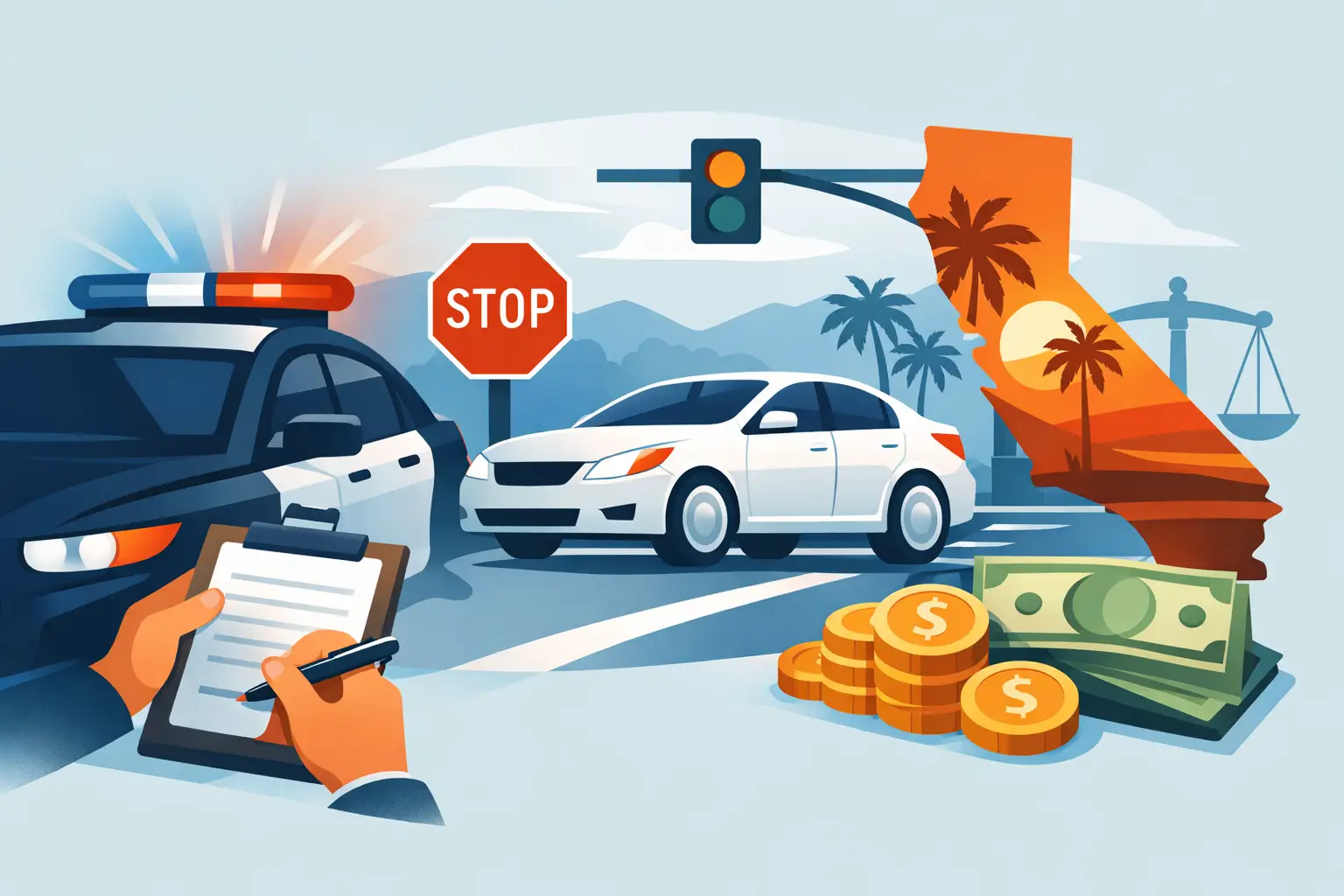
A California stop-sign citation can look deceptively simple: one code section, one court date, and a payment instruction. But if you are asking how much is a rolling stop ticket in California, the useful answer is not just the number printed on a schedule. You also need to know what violation was cited, whether the court amount includes assessments, and what paying could mean for your driving record.
For a typical stop-sign violation under California Vehicle Code section 22450(a), the 2026 California Uniform Bail and Penalty Schedule lists total bail of $233. The amount shown on your citation or court notice controls, and enhanced penalties or local court schedules may affect what you actually owe.
What a rolling stop ticket usually costs in California
Most "rolling stop" tickets involve an allegation that a driver did not make a complete stop at a stop sign. The usual citation is Vehicle Code section 22450(a). The base fine for that offense is relatively low, but California penalty assessments, state and county fees, and other surcharges raise the total substantially.
In many California counties, total bail for a standard VC 22450(a) violation is about $238. Bail is the amount the court lists to resolve the infraction without appearing, subject to the instructions on your notice. It is often casually called the fine, although the total includes more than the statutory base fine.
Do not assume every stop-related ticket has the same price. A citation for failing to stop at a red light is generally a different violation, often under Vehicle Code section 21453, and can carry a much higher total amount. A ticket involving an accident, alleged unsafe turning, a commercial license issue, or another added violation may also cost more.
The amount on your citation or the court's notice controls. Check the code section, county, due date, and listed bail before relying on an online estimate.
Why the total is higher than the base fine
California traffic penalties are built in layers. A stop-sign violation may have a modest base fine, but required assessments and fees can add several times that amount. Those additions may support court operations, state programs, emergency medical services, and other designated funds.
That is why two drivers can both say they received a "rolling stop ticket" yet report different totals. One may be describing the base fine. Another may be describing total bail after assessments. A third may have paid for traffic school or incurred an additional court-related charge.
County schedules can also change. Courts periodically update their uniform bail schedules, and a local schedule is more reliable than an old forum post, social-media comment, or estimate from a friend.
What California law requires at a stop sign
Under VC 22450(a), a driver approaching a stop sign must stop at the limit line. If there is no limit line, the driver must stop before entering the crosswalk. If there is neither a limit line nor a crosswalk, the required stop is at the entrance to the intersecting roadway.
A complete stop is the key issue. Slowing significantly but continuing to roll forward can still support a citation if the officer concludes the vehicle never fully stopped at the legally required location.
The location matters, too. Some intersections have faded markings, unusual sight lines, obstructed stop signs, construction activity, or an unclear relationship between the sign, crosswalk, and limit line. Those facts do not automatically defeat a ticket. They can, however, matter when assessing what the officer could observe and whether the alleged violation matches the physical layout of the intersection.
The costs that may continue after you pay
The court amount is not always the full financial impact. A moving-violation conviction for a stop-sign ticket generally adds one point to your California driving record. Insurers set their own underwriting and pricing rules, so there is no universal premium increase. Still, a point can affect insurance rates, especially for newer drivers, drivers with prior incidents, rideshare drivers, and households already carrying a high premium.
For some eligible drivers, traffic school may keep the point from being shown to insurers in the usual way. It is not free. You may pay the ticket amount, an administrative fee, and the cost of the traffic school course. Eligibility is determined by the court and depends on the circumstances, your record, and the type of license and vehicle involved.
Traffic school also has limits. California drivers are generally limited to using it for an eligible violation once every 18 months, measured from the date of the prior violation. Commercial driving circumstances can be different, and drivers should read the court's eligibility instructions carefully.
Paying the bail may seem like the fastest option, but it commonly resolves the case as a conviction. Before paying, consider the listed amount, traffic-school eligibility, your record, and whether the citation facts deserve a closer review.
How to check a rolling stop ticket before responding
Have a California traffic ticket? JusticeDrive can review your citation details and identify possible issues worth checking before you decide what to do next. Start your free citation analysis.
Start with the ticket itself. Confirm that your name, license information, vehicle, location, date, time, and cited code section are accurate. A paperwork issue alone does not guarantee dismissal, but errors can be relevant when they affect identification, notice, or the clarity of the allegation.
Then preserve the facts while they are fresh. Write down where your vehicle stopped, the position of the stop sign, whether there was a limit line or crosswalk, traffic conditions, visibility, weather, and where the officer was positioned. If a passenger was present, ask them to record their independent recollection rather than trying to reconstruct it weeks later.
Photos or video of the intersection can be useful when they fairly show the roadway conditions. Document faded or missing markings, vegetation, parked vehicles, construction, curves, hills, or other sight-line issues. If you have dashcam footage, preserve the original file promptly. Do not edit it in a way that removes context.
A practical review also looks at the officer's observation opportunity. Was the officer directly positioned to see the stop line and your wheels? Could another vehicle have obstructed the view? Was the cited location precise enough to identify the applicable stop point? These are fact questions, not automatic defenses, but they can help you decide whether to pay, seek traffic school, or contest the allegation.
Your options after receiving the citation
You generally need to act by the date on the citation or court notice. Ignoring a ticket can create additional problems, including a hold or added consequences from the court. Follow the instructions issued by the court handling your case.
Depending on the court and your circumstances, you may be able to pay, request traffic school if eligible, appear in court, or contest the ticket through a trial by written declaration or another available process. Court procedures and remote-hearing options vary by county, so use the instructions tied to your specific case rather than assuming another county's process applies.
If you want to contest the citation, preparation matters more than broad arguments about fairness. Focus on the specific allegation, the legal stop location, the available evidence, the officer's observation conditions, and your court paperwork. A complete record is more useful than a vague claim that you "definitely stopped."
JusticeDrive can provide a free, California-specific initial review of an uploaded citation before you decide how to proceed. The review is designed to identify potential factual, evidence, road-condition, officer-procedure, and paperwork issues for your consideration. JusticeDrive is not a law firm, does not provide legal representation, and cannot guarantee a dismissal, reduced fine, or any court outcome.
A rolling stop ticket may be about $238, but the decision is rarely only about $238. Read the cited code, preserve what you remember, check the court deadline, and make your choice before a quick payment turns a citation you never examined into a completed conviction.